Latest Blog
The surgery is one third of your recovery. The rehabilitation is the other two. We run protocol-specific post-operative programmes for knee replacements, ACL reconstructions, spine surgery, rotator-cuff repairs and fracture recovery — coordinated with your surgeon and measured milestone by milestone.
The best surgeon in the world can hand you a beautifully reconstructed ACL, and if the rehabilitation is generic, unsupervised or rushed, you're a re-injury statistic within 18 months. Post-surgical outcomes are 30% surgical technique and 70% rehabilitation quality — and the evidence for that ratio is now unambiguous.
Every post-operative programme we write starts with a call to your operating surgeon. We confirm the procedure specifics, the surgeon's preferred protocol, and the milestone criteria they want us to hit. Only then do we design your programme. This is the difference between 'physiotherapy after your knee replacement' and 'the specific protocol your knee surgeon wants for your specific TKR at your specific week-4, week-8 and week-16 milestones.'
For working professionals, we build return-to-work timelines into the plan from day one. Cleared to drive, cleared for stairs, cleared for a full desk day, cleared for a business trip. Because for the BKC-commuting patient, those milestones matter as much as the range-of-motion ones.
Nine surgical presentations we manage weekly — each with its own written protocol.
Structured strength and stability rebuilding after ACL reconstruction surgery.
Careful, graded rehab following disc, fusion or decompression spine surgery.
Phase-wise shoulder recovery protocols after rotator cuff repair surgery.
Restoring strength, range of motion and confidence after a bone fracture.
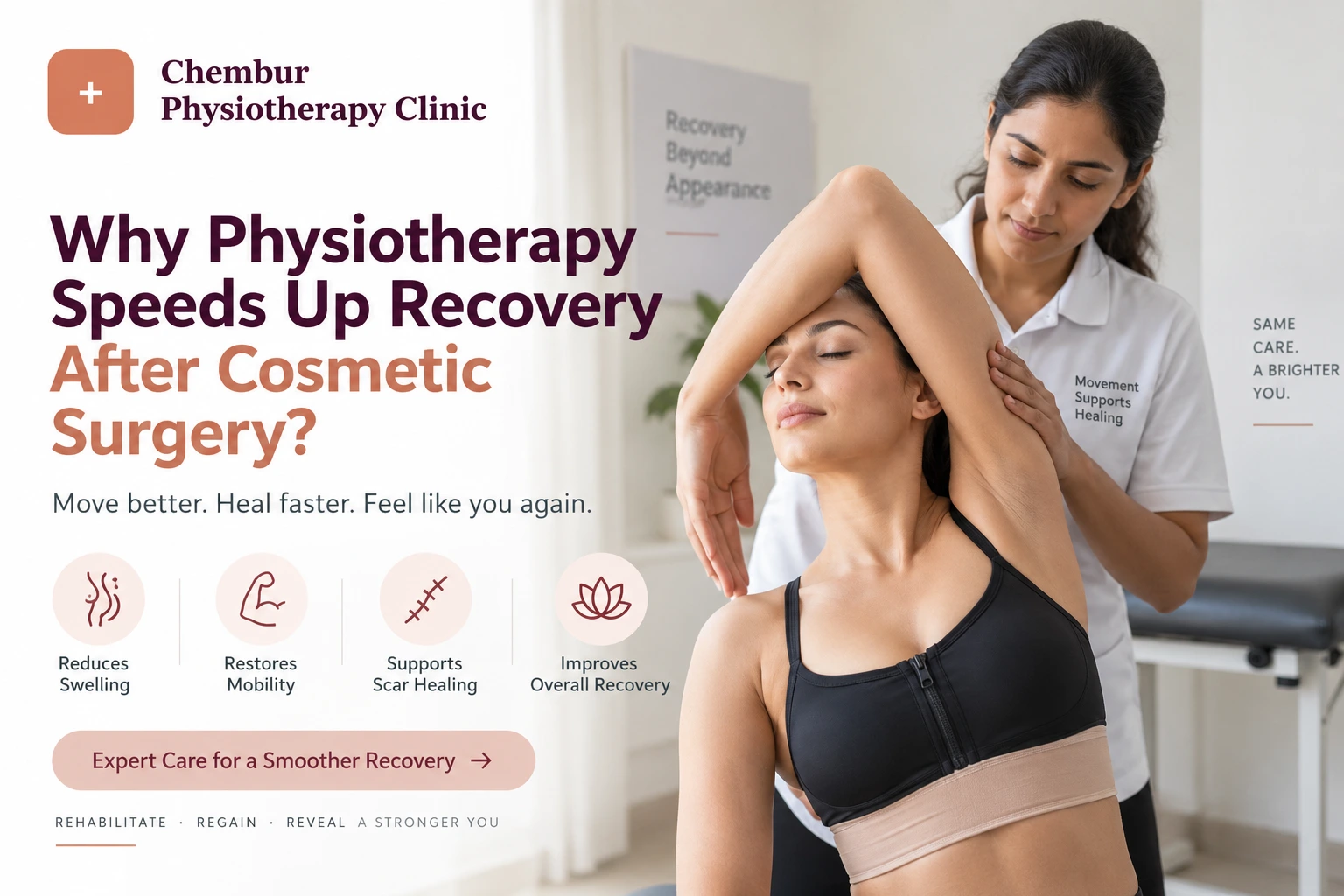
Gentle post-operative physiotherapy to support healing after cosmetic procedures.
Restoring full bend, straightening and walking after knee replacement surgery.
Rebuilding strength, mobility and confidence after hip replacement surgery.
The single most common mistake in post-surgical recovery is starting rehabilitation too late. These signs mean 'today, not next month'.
Most major joint surgery benefits from rehab starting inside the first three days.
If range is going backwards, every day of delay makes recovery harder.
Compensatory gait patterns become permanent if not corrected early.
Beyond the expected post-op window — needs assessment, not more ice.
A staged, surgeon-liaised pathway from hospital discharge to full functional return.
We call your surgeon or read their operative note — protocol confirmed before session one.
Swelling control, protected range of motion, early ambulation with surgeon's precautions respected.
Progressive strength, endurance and gait quality work — this is the phase that determines your final range.
Driving, gym, sport, business travel — every function you came in with, restored, tested and cleared.
Everything needed to progress a post-surgical case safely from bed to boardroom.
Gentle scar mobilisation to prevent adhesions and restore glide.
Post-op pain modulation without pharmacological dependence.
Photobiomodulation to accelerate tissue healing.
Joint mobilisation once your surgeon's protocol allows.
Video-analysed walking pattern correction to eliminate compensatory limps.
Bodyweight to weighted, in a periodised programme matched to your protocol.
Where a pool-based phase would accelerate recovery, we coordinate access.
Objective testing at protocol-specified milestones — nothing guessed.
This is the single area of physiotherapy where the difference between good and mediocre rehab is measurable in months.
Structured, surgeon-liaised protocols beat generic rehab on every measured timeline.
The range you finish with at week 12 is largely locked in by month six.
Structured programmes reduce stiffness, weakness and chronic post-op pain.
Return-to-work milestones built into the programme from session one.
First-month care delivered at your address — no post-op travel required.
Your surgeon and physiotherapist working from the same milestone map.
From surgeon's discharge summary in hand, to your first post-op business trip.
We speak to (or read the discharge notes from) your surgeon — protocol confirmed.
Assessment at your address, first treatment, protection and early mobility.
Swelling, range, gait, ambulation — the foundation phase.
Progressive loading, functional retraining, gym-based rehabilitation.
Driving, work, sport, travel — each milestone tested and cleared.
Written maintenance plan to keep the surgical outcome intact for years.
"Left total knee replacement at 66. Chembur Physiotherapy's home visits started 48 hours after discharge — the surgeon and Dr. Menon spoke directly on day one. Week 8 I was walking Diamond Garden pain-free. Week 14 back to gentle yoga. The surgeon told me my week-12 range was ahead of his average patient by 15 degrees. The rehabilitation made the surgery worth it."
Quick answers to questions our Chembur patients ask most often.
Latest Blog