Chembur is a city of active people. Early mornings bring joggers to the tracks and open grounds, evenings fill up with cricket, football, badminton, and tennis, and gyms across the neighbourhood stay busy well into the night. With that much activity, sports injuries are bound to happen, and they affect everyone from school-level players to weekend warriors and seasoned competitive athletes.
The right treatment at the right time makes a big difference. A well-managed injury heals faster, returns you to your sport more safely, and is far less likely to come back. A neglected one can turn into a long-term problem.
In this guide, we cover five of the most common sports injuries we treat at our Chembur clinic, what they typically feel like, and how physiotherapy helps you recover and return to play.
1. Ankle Sprain
What it is: An ankle sprain happens when the ligaments on the outer side of the ankle stretch or tear, usually after rolling the foot inward while running, landing from a jump, or stepping on an uneven surface. It is one of the most common injuries in football, cricket, basketball, and badminton.
What it feels like:
- Pain and swelling around the outer ankle
- Bruising that appears within a day or two
- Difficulty putting weight on the foot
- A feeling of instability or “giving way” once the pain settles
How physiotherapy helps: Many people rest an ankle sprain until the pain fades and then return to sport, which is one of the main reasons sprains keep recurring. The ligaments, balance system, and surrounding muscles all need rehabilitation. Treatment reduces swelling early, restores movement, rebuilds strength, and retrains balance and reaction speed. If you have had repeated twists, our approach to ankle sprain treatment focuses on making the ankle stable again, not just pain-free.
2. ACL Injury
What it is: The anterior cruciate ligament (ACL) is one of the main stabilisers of the knee. It is typically injured during sudden stops, pivots, awkward landings, or direct contact, common in football, cricket, kabaddi, and badminton.
What it feels like:
- A sudden pop or tearing sensation in the knee
- Rapid swelling within hours
- The knee feeling unstable or buckling
- Difficulty walking or turning, especially soon after the injury
How physiotherapy helps: Whether surgery is needed or not, structured rehabilitation is the backbone of ACL recovery. It restores knee movement, rebuilds thigh and hip strength, retrains balance and landing mechanics, and prepares you gradually for cutting and pivoting. Our ACL rehabilitation programme follows clear milestones, so you return to sport when your knee is genuinely ready, not just when it feels better. That matters because returning too early is a major reason for re-injury.
3. Shoulder Injuries (Including Rotator Cuff Problems)
What it is: The shoulder is the most mobile joint in the body, which also makes it more vulnerable. Overhead sports like cricket bowling, swimming, tennis, badminton, and gym exercises such as overhead presses can irritate or strain the rotator cuff tendons and other shoulder structures. Falls and collisions can cause sprains, dislocations, and strains.
What it feels like:
- Pain on lifting the arm overhead or reaching behind
- A deep ache in the shoulder, sometimes at night
- Weakness or fatigue when throwing, serving, or swimming
- Clicking or a pinching sensation with certain movements
How physiotherapy helps: Shoulder problems rarely come from the shoulder alone. Weak shoulder blade muscles, stiff upper backs, and poor throwing or stroke technique often play a part. Treatment eases pain, restores movement, strengthens the rotator cuff and shoulder blade stabilisers, and corrects the movement pattern behind the problem. Our care for shoulder injuries is built around getting you back to throwing, swimming, or lifting without pain.
4. Tennis Elbow
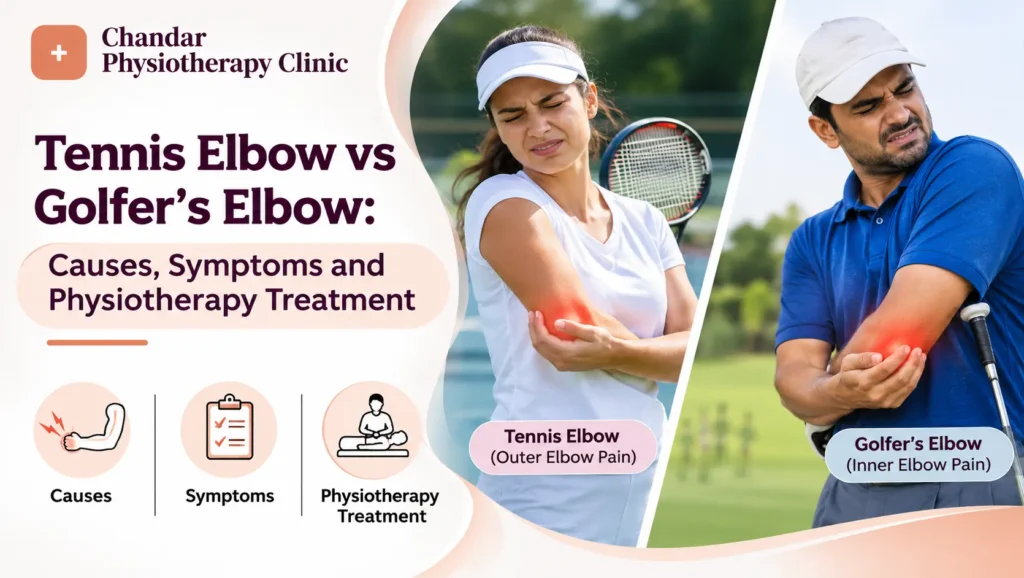
What it is: Despite the name, tennis elbow affects far more than tennis players. It is an overuse problem of the tendons on the outer side of the elbow, triggered by repetitive gripping and wrist movements. Racket sports, cricket, weight training, and even long hours of computer or hand work can bring it on.
What it feels like:
- Pain on the outer side of the elbow
- Pain that worsens when gripping, lifting, or twisting the wrist
- Tenderness when pressing on the bony bump on the outside of the elbow
- Weak grip, such as difficulty holding a racket, bat, or even a coffee cup
How physiotherapy helps: Rest alone rarely solves tennis elbow, because the tendon needs progressive loading to heal properly. Treatment combines pain relief, manual techniques, tendon-loading exercises, forearm and shoulder strengthening, and advice on grip, equipment, and technique. Our dedicated tennis elbow physiotherapy helps you recover strength and get back to your sport or work comfortably.
5. Running Injuries
What it is: Running is one of the most popular fitness activities, and one of the most common sources of overuse injuries. Runner’s knee, shin splints, Achilles tendon pain, IT band syndrome, and foot pain typically develop when mileage, speed, or intensity increases faster than the body can adapt. Footwear, running surface, technique, and muscle weakness all contribute.
What it feels like:
- Pain around the knee, shin, heel, or foot that appears during or after runs
- Pain that starts mild and gradually worsens if ignored
- Stiffness in the morning or after rest
- A dull ache that lingers after activity
How physiotherapy helps: We look at your training load, running technique, strength, flexibility, and footwear to find what is overloading your body, then treat the painful tissue and correct the cause. This is the focus of our running injury physiotherapy, which helps runners recover and, just as importantly, stay injury-free once they return.
Why Sports Injuries Need Proper Rehabilitation?
Sports injuries do not simply end when the pain fades. Pain usually settles well before the tissue has regained full strength, control, and resilience. If you return to sport at that stage, you are more likely to injure the same area again, or to injure a different one because of the way you compensate.
Proper rehabilitation aims to:
- Reduce pain and swelling in the early phase
- Restore full range of movement
- Rebuild strength, stability, and balance
- Retrain sport-specific movements such as running, jumping, throwing, and cutting
- Correct the underlying causes, such as weakness, poor technique, or overload
- Prepare you for a safe, gradual return to play
For the strength and fitness side of recovery, a structured strength and conditioning programme helps athletes rebuild the capacity they need to perform and to protect themselves from repeat injuries.
What to Expect at Your First Sports Physiotherapy Visit?
Every athlete and every injury is different, but a typical visit includes:
- A detailed history of how the injury happened, your sport, training routine, and previous injuries
- A physical examination of movement, strength, swelling, and stability
- Functional testing, such as balance, hopping, squatting, or sport-specific movements
- A clear diagnosis and plan, including what to do, what to avoid, and a realistic timeline
- Hands-on treatment and guided exercises to begin your recovery straight away
For a broader look at how we support athletes at every level, see our sports physiotherapy services.
When to Seek Help Straight Away?
Get medical attention urgently if you have severe pain after a fall or collision, cannot bear weight, notice obvious deformity, feel numbness or tingling, or have significant swelling that develops rapidly. For less severe injuries, book a physiotherapy assessment if pain lasts more than a few days, keeps returning, or is affecting your performance.
Simple Tips to Prevent Sports Injuries
- Warm up properly. Spend 5 to 10 minutes on dynamic movements before training.
- Build up gradually. Increase distance, speed, or weight in small steps.
- Strengthen regularly. Strong hips, core, and legs protect your joints.
- Use the right gear. Wear supportive footwear and suitable equipment.
- Include rest days. Recovery is when your body adapts and gets stronger.
- Work on technique. Poor form is a leading cause of overuse injuries.
- Do not play through pain. Early treatment is much simpler than treating a long-standing injury.
Conclusion
Ankle sprains, ACL injuries, shoulder problems, tennis elbow, and running injuries are among the most common issues we see in athletes and active people across Chembur. Each one heals best with an accurate diagnosis, a structured recovery plan, and a safe, gradual return to sport.
At Chembur Physiotherapy, we work with sportspeople of all levels to treat the injury, correct the cause, and rebuild the strength and confidence to get back to play. If an injury is keeping you off the field, the track, or the court, book an assessment with Chembur Physiotherapy and start your recovery the right way.