Pregnancy and childbirth transform your body in profound ways. While the miraculous moment of delivery is undeniably special, the months following birth bring significant physical, emotional, and psychological adjustments. Your body needs time to heal, your strength needs rebuilding, and your core needs reactivation.
One of the most common questions new mothers ask is: “When can I start exercising?” The answer isn’t one-size-fits-all—it depends on your delivery type, recovery progress, and individual circumstances. This comprehensive guide walks you through the postnatal recovery timeline and explains when and how physiotherapy can support your healing and strength restoration.
Understanding Postnatal Recovery
Childbirth, whether vaginal or cesarean, represents significant physical trauma. Your body underwent months of hormonal changes, structural adaptations, and physical demands—then delivered a baby. Recovery isn’t instantaneous, and pushing too hard too soon can delay healing and create long-term problems.
The Healing Timeline
Week 1: The Fourth Trimester Begins
The first week after delivery is about rest and basic recovery:
- Lochia: Vaginal bleeding continues as your uterus sheds its lining (normal for 3-6 weeks)
- Perineal healing: If you had tearing or episiotomy, healing begins
- Uterine involution: Your uterus begins shrinking back to pre-pregnancy size
- Hormonal changes: Dramatic shifts in hormones (particularly estrogen and progesterone)
- Energy: Extreme fatigue is normal as your body prioritizes healing
- Activity: Pelvic floor rest is essential; walking is the only recommended activity
Weeks 2-6: Early Healing Phase
- Tissue healing: Perineal tears typically heal within 2-3 weeks; episiotomies within 3-4 weeks
- Bleeding reduces: Lochia gradually decreases
- Energy improvement: Sleep deprivation may mask improving energy
- 6-week checkpoint: Medical clearance typically provided at this visit
- Activity: Gentle walking can increase; other activities remain restricted
Weeks 6-12: Progressive Recovery Phase
- Tissue remodeling: Internal healing continues beyond visible signs
- Pelvic floor function: Begins normalizing if properly supported
- Core activation: Superficial tissues heal; deep core remains weak
- Separation closure: Diastasis recti (abdominal separation) begins improving with proper exercise
- Activity: After medical clearance, gradual return to low-impact exercise can begin
- Exercise: Physiotherapy-guided rehabilitation becomes valuable
3-6 Months: Strengthening and Return Phase
- Significant improvement: Most women feel substantially recovered
- Ongoing tissue remodeling: Collagen remodeling continues
- Progressive strengthening: Strength returns with consistent exercise
- Continued adaptation: Body continues adjusting to non-pregnant physiology
- Activity: Return to moderate exercise, sports, and activities becomes possible
- Physiotherapy: Focuses on strength, power, and return to sport/activity
6-12 Months: Long-Term Remodeling
- Collagen remodeling: Takes up to 12 months to complete
- Scar tissue maturation: Perineal scars fully mature over 12 months
- Full strength return: Progressive strengthening continues
- Performance: Return to pre-pregnancy fitness and performance levels
- Prevention: Focus shifts to preventing future complications
Vaginal Delivery vs. Cesarean Section: Different Timelines
Vaginal Delivery Recovery
Immediate Recovery (First 2 weeks)
- Perineal trauma (tearing and/or episiotomy)
- More rapid bleeding cessation than cesarean
- Faster initial involution of uterus
- Less surgical recovery needed
- Can walk and move more freely
Early Phase (Weeks 2-6)
- Perineal healing is the primary concern
- Pain may limit activity more than other factors
- Pelvic floor rest crucial for healing
- Medical clearance typically at 6 weeks
- Can usually begin gentle movement
Progressive Phase (Weeks 6+)
- Perineal tissue continues remodeling
- Physiotherapy addresses pelvic floor weakness
- Gradually resume normal activities
- Return to exercise guided by pain and function
- Focus on pelvic floor and core rehabilitation
Advantages for Exercise Return
- No abdominal surgical incision
- Faster return to activity possible
- No restriction on core engagement
- Earlier return to running (if pelvic floor strong)
Cesarean Section Recovery
Immediate Recovery (First 2 weeks)
- Surgical incision healing is primary focus
- More significant bleeding than vaginal delivery
- Anesthesia recovery (if spinal)
- Pain management critical
- Movement limited by incision healing needs
- Hospital stay typically longer
Early Phase (Weeks 2-6)
- Incision healing is paramount
- Internal healing (uterine repair) continues
- Pain may significantly limit movement
- Restrictions on heavy lifting and strenuous activity
- Gentle walking appropriate; other exercise restricted
- Medical clearance typically at 6 weeks
Progressive Phase (Weeks 6+)
- Superficial incision healed; internal healing ongoing
- Scar tissue formation and maturation
- Core engagement carefully reintroduced
- Pelvic floor rehabilitation important
- Gradual return to exercise with care
- Physiotherapy valuable for scar management and core rebuilding
Delayed Return to Activity
- More conservative timeline than vaginal delivery
- Core engagement must be carefully managed
- Return to running typically later (12+ weeks)
- Return to high-impact activities later
- Scar tissue management important for long-term outcomes
The Critical Role of Pelvic Floor Recovery
Your pelvic floor muscles deserve special attention—they’re often overlooked but absolutely crucial.
What Happened During Pregnancy and Delivery
Pregnancy Changes
- Pelvic floor muscles stretched as baby grew
- Ligaments and connective tissue loosened from hormones
- Muscles worked harder supporting increased weight
- Increased pressure from growing uterus
Delivery Impact (Vaginal)
- Direct trauma from baby passing through
- Possible tearing requiring healing
- Significant stretching of all pelvic floor structures
- Possible nerve damage from stretching
- Muscle fatigue from prolonged labor
Cesarean Impact
- No direct trauma to pelvic floor
- But hormonal effects and pregnancy changes persist
- Reduced activation during pregnancy
- Weakness from lack of use during pregnancy
- Pelvic floor often ignored during early cesarean recovery
Common Postnatal Pelvic Floor Issues
Urinary Incontinence
- Stress urinary incontinence (leaking with cough, sneeze, exercise) is common
- Affects 35-50% of postpartum women
- Often improves with pelvic floor rehabilitation
- Can persist without proper treatment
Fecal Incontinence
- Less common but more distressing
- Possible after significant tearing
- Requires specialized pelvic floor assessment
- Greatly improved with proper rehabilitation
Pelvic Pain
- May indicate improper healing
- Can arise from scar tissue restrictions
- May develop from excessive pelvic floor tension
- Requires assessment to differentiate causes
Sexual Dysfunction
- Pain during intercourse (dyspareunia)
- Reduced sensation or pleasure
- Often related to pelvic floor dysfunction
- Improves significantly with rehabilitation
Pelvic Organ Prolapse
- Uncommon but serious complication
- Pelvic organs descend due to weakened support
- Symptoms include pelvic pressure or heaviness
- Requires specialized physiotherapy
When to Start Pelvic Floor Rehabilitation
6-Week Mark and Beyond
- After medical clearance, pelvic floor assessment is valuable
- Don’t wait for problems to develop—prevention is key
- Early intervention prevents complications
- Proper pelvic floor rehabilitation supports all postnatal recovery
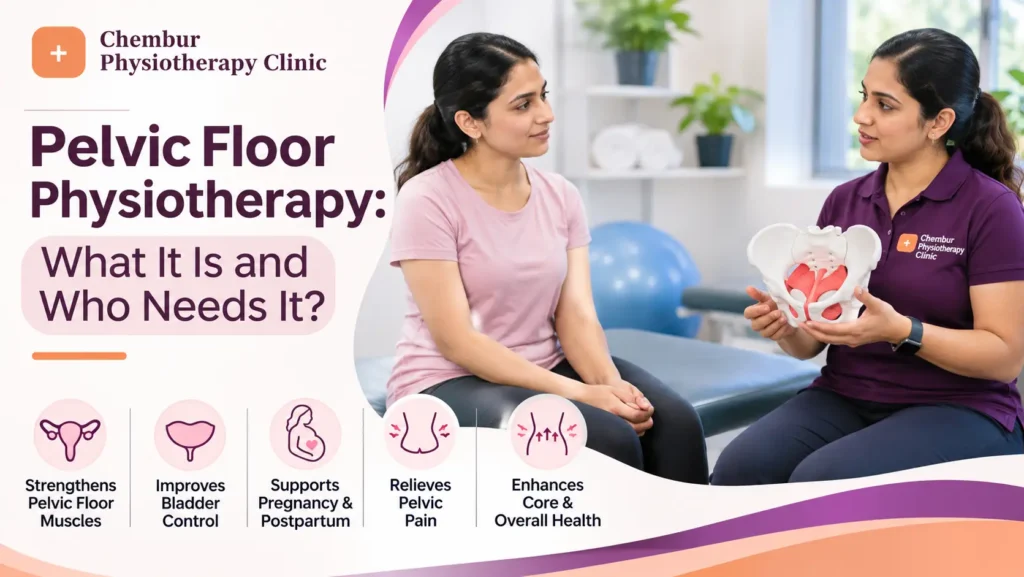
Pelvic floor physiotherapy is a specialized area requiring proper assessment and treatment.
Postnatal Physiotherapy: What to Expect
Postnatal physiotherapy is different from general exercise—it addresses the specific effects of pregnancy and delivery on your body.
Initial Assessment (6+ weeks postpartum)
Your physiotherapist will:
Medical History Review
- Type of delivery (vaginal vs. cesarean)
- Complications during pregnancy or delivery
- Current symptoms and concerns
- Activity level and goals
- Medical clearance confirmation
Physical Examination
- Posture assessment and alignment
- Abdominal separation (diastasis recti) measurement
- Scar tissue assessment (if cesarean)
- Pelvic floor function evaluation
- Core muscle strength testing
- Overall strength and mobility assessment
Pelvic Floor Assessment
- Internal examination (if appropriate and consented)
- Assessment of muscle strength and endurance
- Evaluation of coordination and relaxation
- Identification of tension or weakness
- Discussion of sensations and function
Functional Assessment
- How you move in daily activities
- Ability to perform household tasks
- Exercise tolerance
- Breathing patterns and coordination
Treatment Components
Pelvic Floor Rehabilitation
Postnatal physiotherapy begins with pelvic floor retraining:
- Pelvic floor muscle activation: Learning to properly engage muscles
- Strength progression: Gradual strengthening over weeks
- Endurance training: Building stamina in pelvic floor muscles
- Coordination retraining: Timing muscle engagement with activities
- Relaxation: Teaching proper relaxation between contractions
- Functional integration: Using muscles correctly during daily activities
Core Rehabilitation
Your abdominal and deep core muscles need careful reactivation:
- Breathing retraining: Proper diaphragmatic breathing
- Transverse abdominis activation: Deep stabilizing muscle engagement
- Progressive core strengthening: Gradual progression from isometric to dynamic
- Diastasis recti management: Bridging abdominal separation with proper exercise
- Integration with pelvic floor: Coordinating core and pelvic floor function
Posture and Movement Retraining
Pregnancy changes your posture; postpartum recovery should restore it:
- Spinal alignment correction: Addressing forward-leaning posture from pregnancy
- Shoulder positioning: Correcting shoulder tension from feeding and baby-carrying
- Hip and pelvis alignment: Restoring proper alignment
- Gait retraining: Correcting walking pattern changes
- Movement patterns: Proper mechanics for daily activities with a baby
Scar Tissue Management (if cesarean delivery)
For cesarean mothers, scar tissue management is important:
- Scar tissue mobilization: Gentle techniques improving tissue mobility
- Desensitization: Reducing nerve sensitivity around scar
- Mobility restoration: Regaining movement restricted by scar
- Appearance improvement: Proper scar management may improve cosmetic outcome
Gradual Return to Activity
Your physiotherapist guides safe progression:
- Walking progression: Increasing duration and pace
- Low-impact exercise: Introduction of stationary cycling, swimming
- Strength training: Progressive resistance work
- High-impact activity: Graduated return to running and sports
- Sport-specific training: Return to your activities safely
Timeline for Specific Activities
Walking
- Week 1-2: Short walks (10-15 minutes), slow pace
- Week 3-6: Progressively longer walks as tolerated
- 6+ weeks: Normal walking with increasing pace and duration
- 3+ months: Can handle any walking without limitation
Low-Impact Cardio (Stationary Cycling, Swimming)
- Vaginal delivery, uncomplicated: 6-8 weeks postpartum
- Cesarean delivery: 8-12 weeks postpartum
- Start: 15-20 minutes, moderate intensity
- Progress: Increase duration and intensity gradually over weeks
- Timeline to regular: 3-4 months to pre-pregnancy levels
Strength Training
- Vaginal delivery: 6-8 weeks postpartum (light weights, high repetitions)
- Cesarean delivery: 8-12 weeks postpartum
- Start: Light resistance, core-focused exercises
- Progress: Gradually increase weight and complexity
- Avoid: Heavy lifting before 12 weeks (especially cesarean)
- Timeline to regular: 4-6 months for return to pre-pregnancy lifting
Running
- Vaginal delivery with strong pelvic floor: 10-12 weeks postpartum
- Vaginal delivery with pelvic floor weakness: 4-6 months or longer
- Cesarean delivery: 12-16 weeks postpartum
- Start: Walk-run intervals, starting with short runs
- Progress: Gradually increase running duration and intensity
- Avoid: Heavy running if pelvic floor weak or leaking occurs
- Impact: Pelvic floor strength is the limiting factor, not cesarean healing
High-Impact Sports (Jumping, Cutting Movements)
- Typical timeline: 4-6 months postpartum
- Requirement: Strong pelvic floor and core foundation
- Assessment: Physiotherapy clearance recommended
- Start: Sport-specific training with controlled progression
- Progress: Return to full sport over weeks
Heavy Lifting
- Vaginal delivery: 8-12 weeks before significant lifting
- Cesarean delivery: 12-16 weeks minimum
- Types to avoid: Lifting babies is okay; heavy groceries or gym equipment avoided
- Progression: Gradually increase weight lifted
- Technique: Proper body mechanics essential
Sexual Activity
- Timeline: 6+ weeks for most women
- Pain: Should not be painful; if so, seek assessment
- Pelvic floor: May affect comfort; therapy can help
- Gradual return: Some women are ready at 6 weeks; others need longer
- Individual variation: Talk with your partner and doctor about readiness
Red Flags: When to Seek Medical Evaluation
Contact your doctor immediately if you experience:
- Excessive bleeding: Soaking through a pad in an hour
- Signs of infection: Fever, foul-smelling discharge, increasing pain
- Chest pain or shortness of breath: Possible serious complication
- Severe headache: Particularly with vision changes
- Severe perineal pain: Not improving with time
- Inability to void urine: After catheter removed
- Severe lower back or pelvic pain: Beyond normal recovery discomfort
- Suicidal thoughts: Postpartum depression requires immediate care
When Physiotherapy May Be Delayed
Some women should delay formal physiotherapy beyond 6 weeks:
- Significant perineal tearing: Third or fourth-degree tears may require longer healing
- Complicated cesarean: Infection or other complications may delay recovery
- Pelvic organ prolapse: May require initial conservative management before intensive therapy
- Significant pain: Address underlying cause first
- Infection: Complete treatment before physiotherapy begins
Your doctor will advise if your situation warrants delayed physiotherapy.
Postnatal Physiotherapy Benefits Beyond Pain Relief
Beyond addressing pain and dysfunction, postnatal physiotherapy provides:
Faster Return to Activities
- Safe progression allows faster return to exercise
- Pelvic floor strength enables return to running and sports
- Core rehabilitation supports all activities
- Fewer restrictions than without therapy
Prevention of Complications
- Early pelvic floor rehabilitation prevents chronic incontinence
- Proper core work prevents chronic back pain
- Scar tissue management prevents long-term restrictions
- Posture correction prevents neck and shoulder pain
Confidence and Empowerment
- Understanding your recovery builds confidence
- Learning proper movement mechanics empowers you
- Knowing what’s normal vs. concerning provides peace of mind
- Expert guidance removes uncertainty
Faster Return to Pre-Pregnancy Fitness
- Structured rehabilitation accelerates progress
- Professional guidance prevents setbacks
- Proper progression reduces re-injury risk
- Return to sports becomes possible sooner
Long-Term Pelvic Health
- Early intervention prevents years of incontinence
- Proper rehabilitation reduces future prolapse risk
- Core strength prevents future back problems
- Sets foundation for long-term health
Common Postnatal Concerns Physiotherapy Addresses
Diastasis Recti (Abdominal Separation)
Pregnancy causes separation of abdominal muscles (rectus abdominis). Postnatal rehabilitation bridges this gap:
- Assessment: Measurement of separation width and depth
- Rehabilitation: Proper exercises to close separation
- Timeline: Typically improves significantly within 3 months with proper exercise
- Prognosis: Most cases resolve; some residual separation is normal
Pelvic Pain
Pain in the pelvic region during or after the postnatal period requires assessment:
- Causes: May be from scar tissue, pelvic floor tension, or inflammation
- Assessment: Thorough evaluation to identify cause
- Treatment: Specific interventions based on diagnosis
- Recovery: Usually improves significantly with proper therapy
Postpartum Back Pain
Lower back pain is common postpartum:
- Causes: Core weakness, posture changes, physical demands of baby care
- Prevention: Early core rehabilitation
- Treatment: Core strengthening and posture correction
- Timeline: Typically improves within 3-6 months with therapy
Neck and Shoulder Pain
Tension in neck and shoulders is common from feeding and baby-carrying:
- Causes: Forward posture, muscle tension, repeated strain
- Prevention: Ergonomic setup for feeding and baby-holding
- Treatment: Stretching, muscle release, posture correction
- Timeline: Often improves quickly with proper positioning
Returning to Sport and Performance Activities
If you were active before pregnancy, you likely want to return to your sport.
Assessment Factors
- Pelvic floor strength (most important for high-impact activities)
- Core strength and endurance
- Cardiovascular fitness
- Sport-specific skills and confidence
- Absence of pain or dysfunction
Return-to-Sport Timeline
- Low-impact activities: 6-8 weeks (cycling, swimming)
- Running: 3-4 months minimum (if pelvic floor strong)
- High-impact sports: 4-6 months minimum
- Competitive sport: Often 6+ months
Graduated Return Protocol
- Phase 1: Sport-specific exercise without sport
- Phase 2: Simulated sport activities with controlled intensity
- Phase 3: Modified sport participation
- Phase 4: Full sport return
Your physiotherapist can guide this progression safely.
The Role of Partner and Family Support
Postnatal recovery isn’t just physical—it’s emotional and social too.
Partner Support
- Encouraging rest and recovery, not rushing return to activity
- Supporting physiotherapy participation
- Helping with household tasks and baby care
- Celebrating progress and recovery milestones
Family Support
- Helping with daily tasks so you can focus on recovery
- Encouraging proper nutrition and hydration
- Supporting mental health and emotional wellbeing
- Allowing rest and recovery time
Conclusion
Postnatal recovery is a gradual process requiring patience, appropriate rest, and structured rehabilitation. While you can begin gentle movement immediately after delivery, formal physiotherapy typically starts around 6 weeks postpartum with medical clearance. From that point, postnatal physiotherapy accelerates your recovery, prevents complications, and enables faster return to your pre-pregnancy activities and fitness levels.
The pelvic floor deserves special attention during postnatal recovery—it’s often overlooked despite being crucial to continence, sexual function, and overall quality of life. Pelvic floor physiotherapy should be considered an essential component of postnatal care, not an optional treatment for problems.
If you’re a new mother in Chembur, we specializes in postnatal recovery and women’s health. Our experienced physiotherapists understand the unique demands pregnancy and delivery place on your body. We provide comprehensive postnatal physiotherapy addressing pelvic floor function, core strength, postural restoration, and safe return to activity.
Whether you’re at the 6-week mark ready to begin rehabilitation, recovering from a complicated delivery, dealing with postnatal pain, or preparing to return to sport, Chembur Physiotherapy provides the expert care and guidance you deserve. We celebrate your recovery journey and support you in becoming stronger, more confident, and fully recovered.
Your body accomplished something extraordinary during pregnancy and delivery. Now let’s help it recover fully and return to peak performance.